Combining the Stacey Matrix and Continuum of Ambiguity for Better Decision Making
Riffing on a recent post I published over at Thought Shrapnel, I want to take a moment to post about the similarities and differences between my Continuum of Ambiguity and the Stacey Matrix.
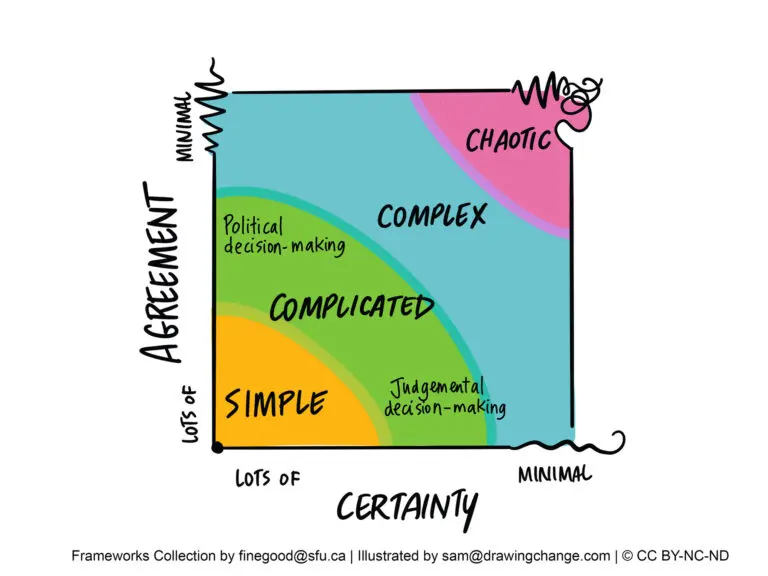
The Matrix, named after Ralph Stacey, is a conceptual framework to help organisations make strategic decisions. Stacey recognised that the traditional linear models of management were inadequate for dealing with the realities of organisational life. He suggested that the level of certainty and the degree of consensus could be used to determine the nature of the decision-making environment.
Both the Stacey Matrix and my Continuum of Ambiguity categorise different states of uncertainty, rejecting simplistic, one-size-fits-all approaches to complex challenges. They advocate for nuanced, context-sensitive responses that acknowledge different types of uncertainty require different strategies.
The Matrix operates along two axes: agreement (the extent of consensus among stakeholders) and certainty (predictability of cause-and-effect relationships). The Continuum, on the other hand, represents a linear progression from vague through generative, creative, and productive ambiguity to dead metaphors. The Continuum suggests that things become more or (usually) less ambiguous over time, whereas the Matrix is a snapshot at a given moment.
Using the Matrix and Continuum together provides a way of gaining both strategic direction and creative flexibility. Organisations can use the Matrix to plot where their challenges sit in terms of agreement and certainty, then let the Continuum of Ambiguity guide how open or specific their language should be.
What do you think? Is this a promising approach? It's certainly something I'd like to try in some client work.