Vagueness, ambiguity, and pragmatism
One of my favourite things about the Web is the ease at which serendipity occurs. We take it for granted these days but occasionally wonderful things happen that make us rediscover the joy of connection.
I was browsing The Setup, a wonderful site that interviews people about the hardware and software they use. Being particularly interested in those using Linux (as I do these days) I was delighted to come across John MacFarlane's interview.
MacFarlane is a Professor of Philosophy at UC Berkeley and his website details both his interests and academic papers. I was delighted to come across a paper entitled Vagueness as Indecision, which is available as a preprint download.
It's been a while since I studied formal logic at university, but I managed to get by while reading this paper, especially as MacFarlane gives homely examples. He takes an expressivist position in taking the position that, "vagueness... is literally indecision about where to draw lines".
On page seven, and quoting a character from Spiderman in passing, MacFarlane states:
In principle, I can use 'that' to refer to any object. But with this freedom comes great responsibility. I must provide my hearers with enough cues to enable them to associate my use of 'this' with the same object I do, or communication will fail. Sometimes this doesn't require anything extra, because it is mutually known that one object is salient, so that it will be assumed to be the referent in the absence of cues to the contrary. Other times it requires pointing. And in some cases simply pointing isn't enough. But in every case, we're obliged to do whatever is required to get our hearers to associate the same object with the demonstrative that we do. If we fail to do this, it will be sheer luck if they understand us.
In my book, The Essential Elements of Digital Literacies I pointed out that productive discourse involves interaction at the overlap of the denotative and connotative aspects of a term or phrase:
 What MacFarlane is pointing out is something similar, but outside the realm of ambiguity. For something to be ambiguous, it cannot be merely vague — although right on the left-hand boundary of that overlap is where the most vague ambiguous terms and phrases reside.
Within that overlap resides the continuum of ambiguity:
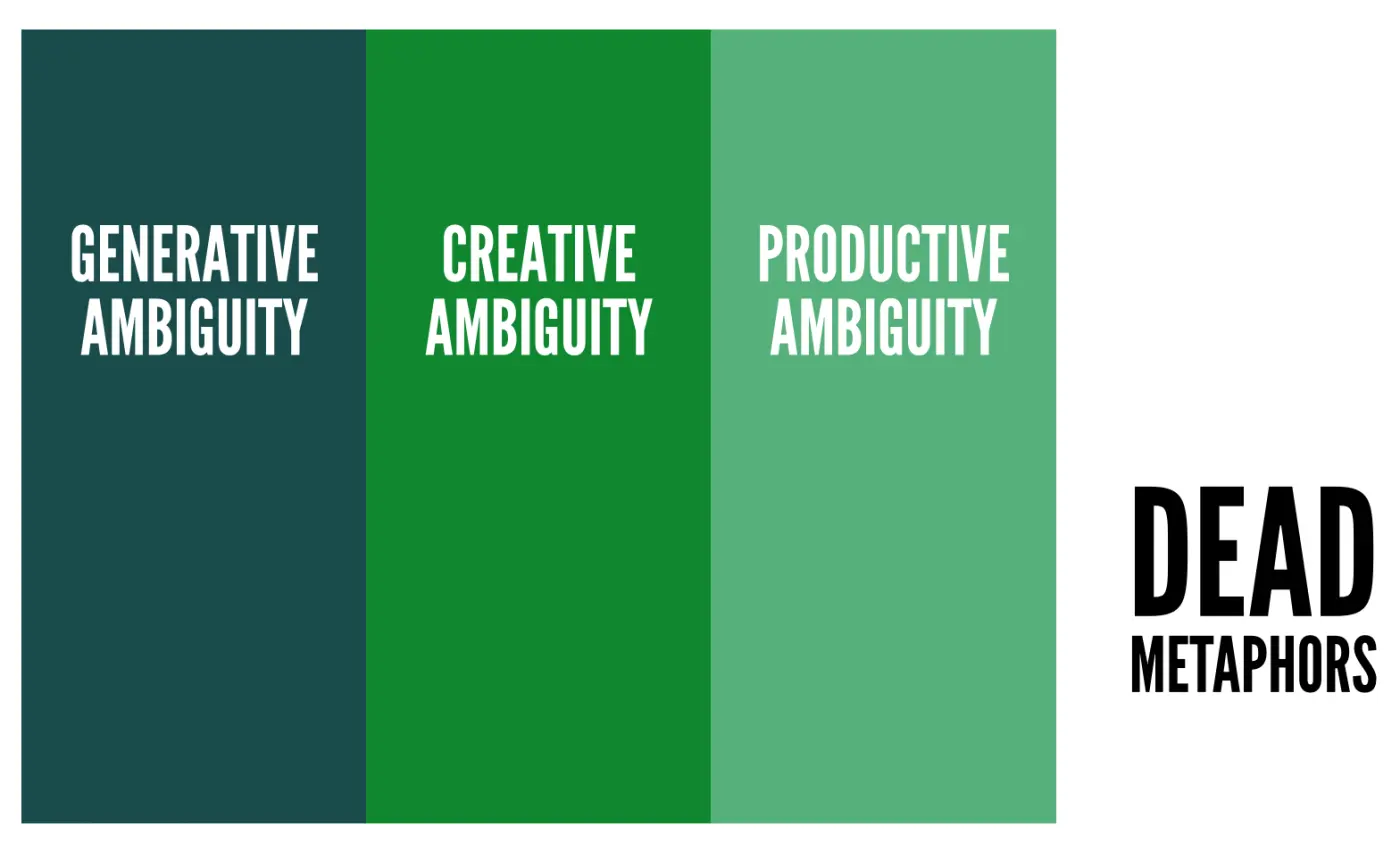 In other words, just as 'dead metaphors' are to the right of Productive Ambiguity and occur when there's denotation but little connotation, so 'vagueness' lies to the left of Generative Ambiguity and, as MacFarlane would put it, happens due to semantic indecision.
The crux of MacFarlane's position is that to have a meaningful interaction, two people have to agree where the 'boundaries' are to what they're discussing:
Here is the upshot. While in using a bare demonstrative like 'this,' one must have a definite object in mind, and successful uptake requires recognizing what object that is, there are no analoguous requirements for the use of 'large.' The speaker need not have in mind a particular delineation (even a 'fuzzy' one), and the hearer need not associate the speaker's use with a particular delineation. What we get instead are constraints on delineations. (p.11)
He continues, continuing his example of a trainee at an apple-sorting factory learning what a 'large' apple is:
Indecision is a practical state; it concerns plans and intentions, not belief. Just as one might plan to buy toothpaste, but not yet have settled on which toothpaste one will choose when confronted with a rack of them at the store, so one might have settled on counting apples greater than 84mm in diameter as large, without having settled on whether one would count a 78mm apple as large.
So for an interlocutor or reader to consider something 'ambiguous' they must 'tolerate' the semantic decisions made by the person with whom they're interacting. If they don't, then the lack delineation leads to vagueness.
I suggest, then, the 'tolerance' intuition can be explained as an awareness that a proposal to draw a sharp line in any particular place would be rejected for pragmatic reasons. Nothing about the meanings of vague words is inconsistent with drawing a sharp boundary; it's just tha the cases in which a proposal to draw a sharp boundary would be sensible are few and unusual.
In other words, we humans are pretty good at getting by using heuristics. We agree to suspend disbelief (and therefore enter the continuum of ambiguity) to see whether doing so is, to use the words of William James 'good in the way of belief'.