Notes from a discussion with Steve Brewis on the Viable System Model (VSM)
Earlier this week, I had an enlightening discussion with Stephen (‘Steve’) Brewis, a systems thinker who knew Stafford Beer. I’d been introduced to Steve (who only lives 12 miles away from me!) by Pauline Roberts, my OU tutor, and fellow north-easterner.
Below are the key points and concepts we covered relating to the VSM and more!
-
Judea Pearl:
- Markov Blanket: A concept in probabilistic graphical models that encapsulates the set of variables shielding a subset of variables from the rest of the network.
- Causal Reasoning: Modelling causal relationships to predict and influence outcomes effectively.
-
Karl Friston:
- Free Energy Principle: Biological systems maintain their states by minimising the difference between predicted and actual sensory inputs, a principle applicable to organisational systems for reducing uncertainty and adapting effectively.
-
Viable System Model (VSM):
- Adaptation and Recursion: Helps organisations adapt to their environments through recursive structures, with each level representing a viable system that operates independently while being part of a larger system.
- Resource Bargain: Negotiation of resources between different parts of the system (System 3 and System 1) to maintain balance and functionality.
-
Causal Planning vs. Feedback Models:
- Causal Planning: Creating plans based on anticipated outcomes.
- Feedback Models: Using feedback to adjust plans dynamically, promoting learning and adaptation rather than adhering to static plans.
-
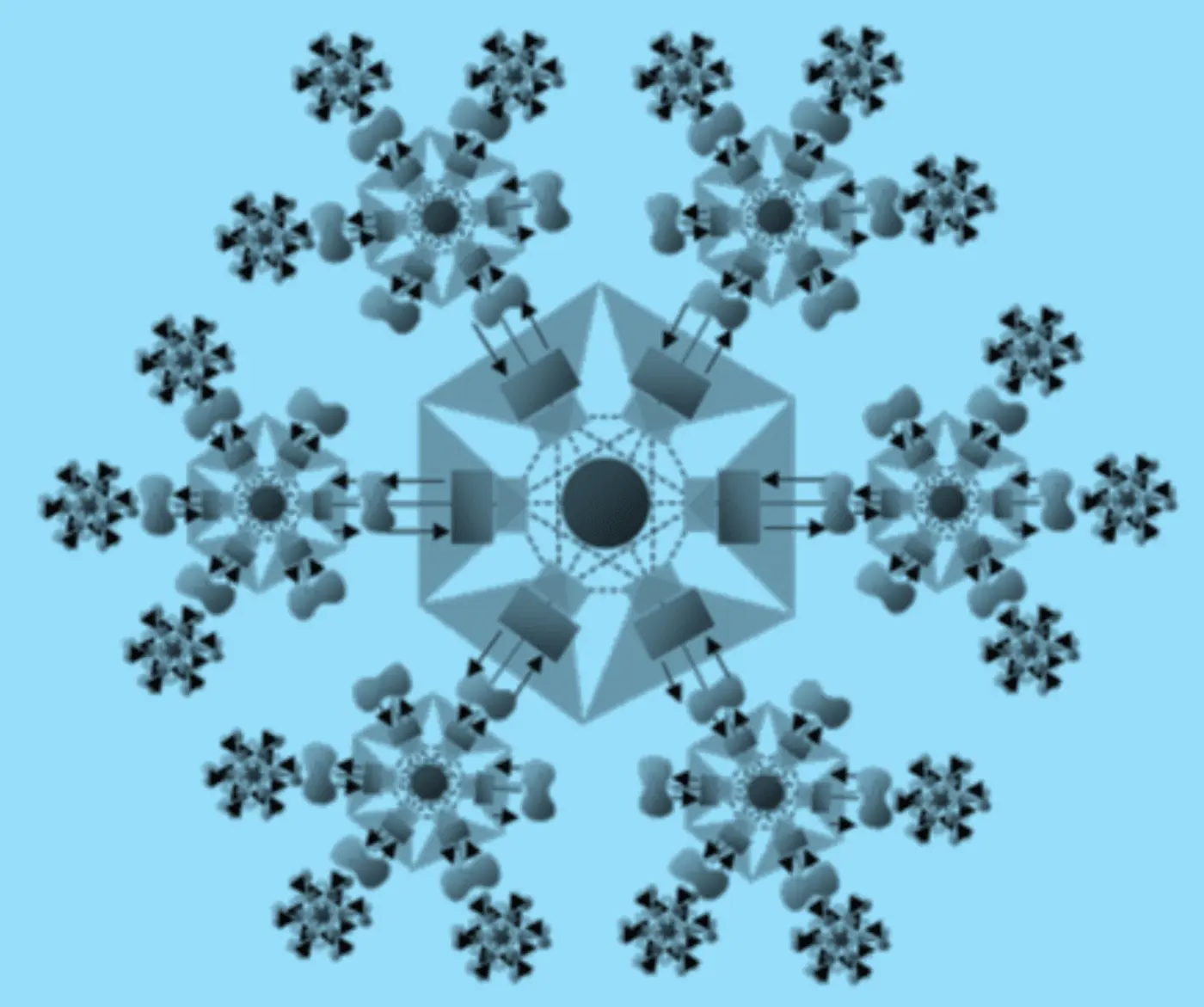
Snowflake representation:
- Unlike the traditional VSM diagram, this allows representation beyond two levels of recursion, allowing a more comprehensive visualisation that grows outward from the centre. (Note: I’m going to try and use this in upcoming MSc work)
-
Play as a Variety Amplifier:
- Engaging with data in a relaxed, creative manner facilitates innovative problem-solving and adaptation. Mandatory play can stifle creativity, highlighting the need for voluntary and spontaneous engagement.
-
Triune Brain Theory
- Paul D. MacLean divided the brain into three parts (reptilian, limbic, and neocortex), which was used by Stafford Beer to model different functional parts of an organisation.
-
Vagus Nerve:
- Plays a vital role in maintaining homeostasis through complex communication networks. In VSM, it metaphorically represents the interconnectedness and communication pathways necessary for system viability.
- The snowflake model’s many touchpoints allow for multi-faceted perspectives and complex interactions, enhancing adaptability and resilience.
-
Hologram and Predictive Models:
- Using holograms with reference and object beams relates to creating comprehensive predictive models that handle surprise and adapt accordingly. (Note: I didn’t fully understand what Steve was talking about here, so will ask next time we meet)