What do we mean by 'open education'?
Socrates must have been one of the most annoying individuals to ever walk the earth. I still don't get why he didn't just leave the city instead of drinking the hemlock at the end of his life. Also, his incessant questioning may well have led to a widely-celebrated 'method' but the dogmatism he displayed over definitions of things beggars belief. Things had definitions and people should act in accordance with objective, but abstract things such as 'justice' and 'virtue'.
I say this by means of introduction, because this is certainly not a post intended to give a single 'definition' of open education, but rather to tease apart its meaning and explore how people use the term. As I mentioned in my doctoral thesis (and related ebook) terms such as 'digital literacy' and 'open education' are examples of zeugmas. In other words, we're never quite sure which part of the phrase on which to place the emphasis: is it 'open education' or 'open education'?
Audrey Watters has already written on this topic and summarises well the problems with considering open education as a prozeugma (i.e. with the emphasis on 'open'):
And it's complicated, of course, by the multiple meanings of that adjective "open." What do we mean when we use the word? Free? Open access? Open enrollment? Open data? Openly-licensed materials, as in open educational resources or open source software? Open for discussion? Open for debate? Open to competition? Open for business? Open-ended intellectual exploration?
The trouble is that it's not just 'open' that's a contested term, but 'education' as well. We tend to conflate 'learning' with 'education' — confusing something that happens inside us with something that happens to us.
A few months ago, as part of the work we were doing at the start of We Are Open Co-op, I asked people within my community what different kinds of 'open' there are in common parlance. I attempted to draw(!) both the examples I'd come up with by way of a stimulus and the contributions I received from people.
Open as in...
- door (you are free to enter)
- for business (you are invited to buy/sell/trade)
- unlocked (you have access to a thing)
- to ideas (you are willing to change your mind)
- transparency (you can see into the 'inside' of something)
- love (you are willing to be vulnerable to others)
- space (you are free to use this resource)
- amendments (you are happy to take on board other people's suggestions)
- exploring (you can discover new things)
- open-ended (you can keep going, potentially forever)
- flexible (you can change this to your own needs)
- no barriers (you do not have to overcome hurdles to get started)
Some of these obviously overlap and, to be honest, some are just better metaphors than others.
Serendipitously, having started this post a few days ago, just yesterday Jim Groom posted about the 'overselling' of the open movement:
I'm quite ambivalent about the open movement more generally these days. What seemed like a movement defined by an anarchic spirit of revolution from 2004-2011 (at least for me—this was a fairly personal narrative) morphed into a fairly tame, almost conservative approach to education: massive lectures and free textbooks. I'm oversimplifying here of course, but at the same time the mad scramble around corporate sponsored MOOCs for elite universities from 2012 until just about now, coupled with the re-branding of OER, at least in the U.S., as predominantly a cost-saving measure left me fairly depressed.
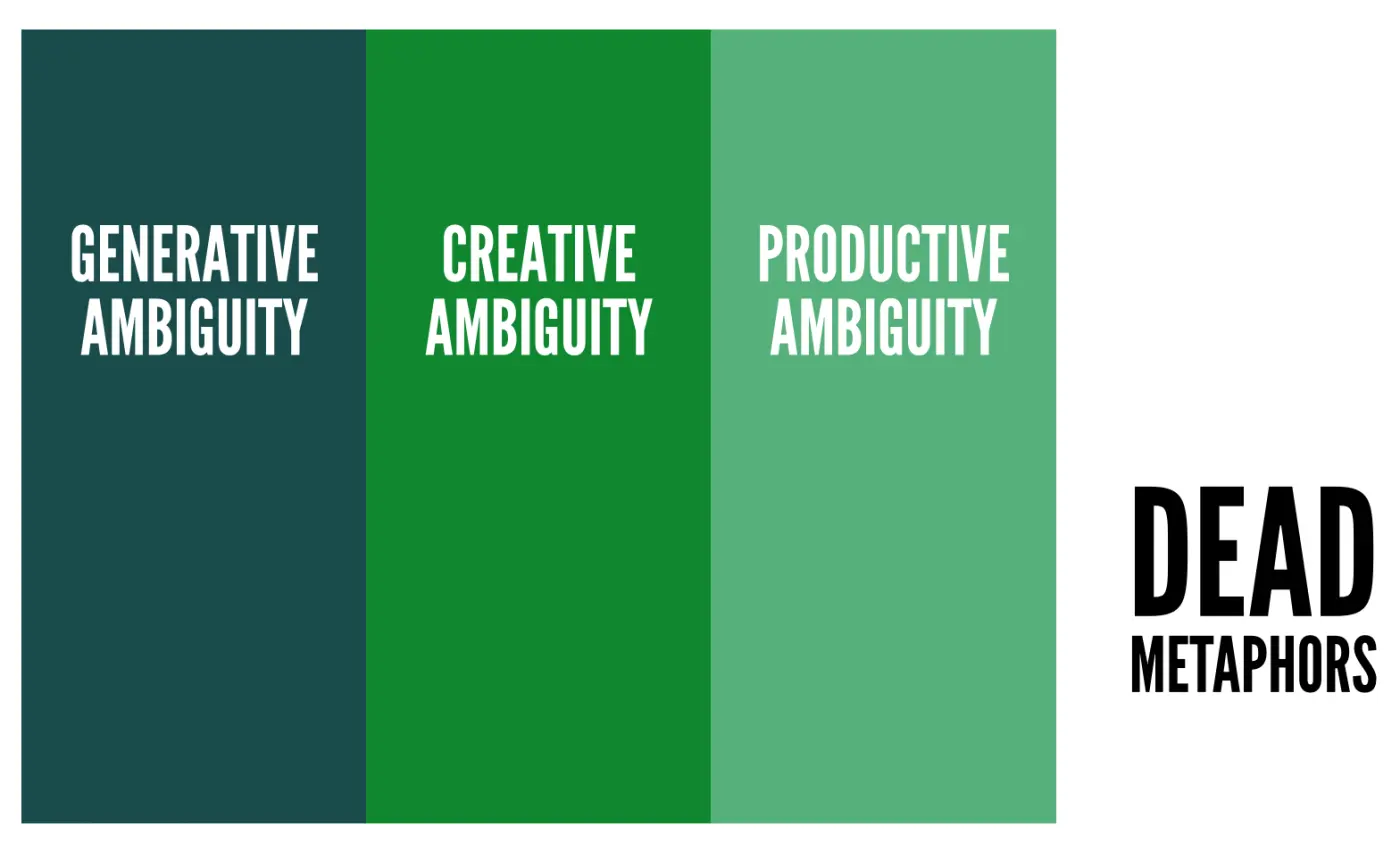
Part of the problem, I think, is that we've so many different definitions of 'open' that it's just not a useful term to use. We get 'openwashing' by big corporates, who — consciously or unconsciously — attempt to move a term like 'open' from something that is a basis for creative ambiguity within a community, towards the realm of 'dead metaphors'.
Other times, we've just shot ourselves in the foot. As Jim Groom mentioned above, there's been far too much focus on access when it comes to 'open' and not enough on ethos. Yes, it's great that we've got so much openly-licensed stuff to use, but have we got an equal number of advocates for open education? I'd actually say that number is on the decline.
Instead, and this is something I keep coming back to, I'd use the diagram below to provide a simple way to show how the open education movement needs to move beyond — well beyond — mere Open Educational Resources (OERs).
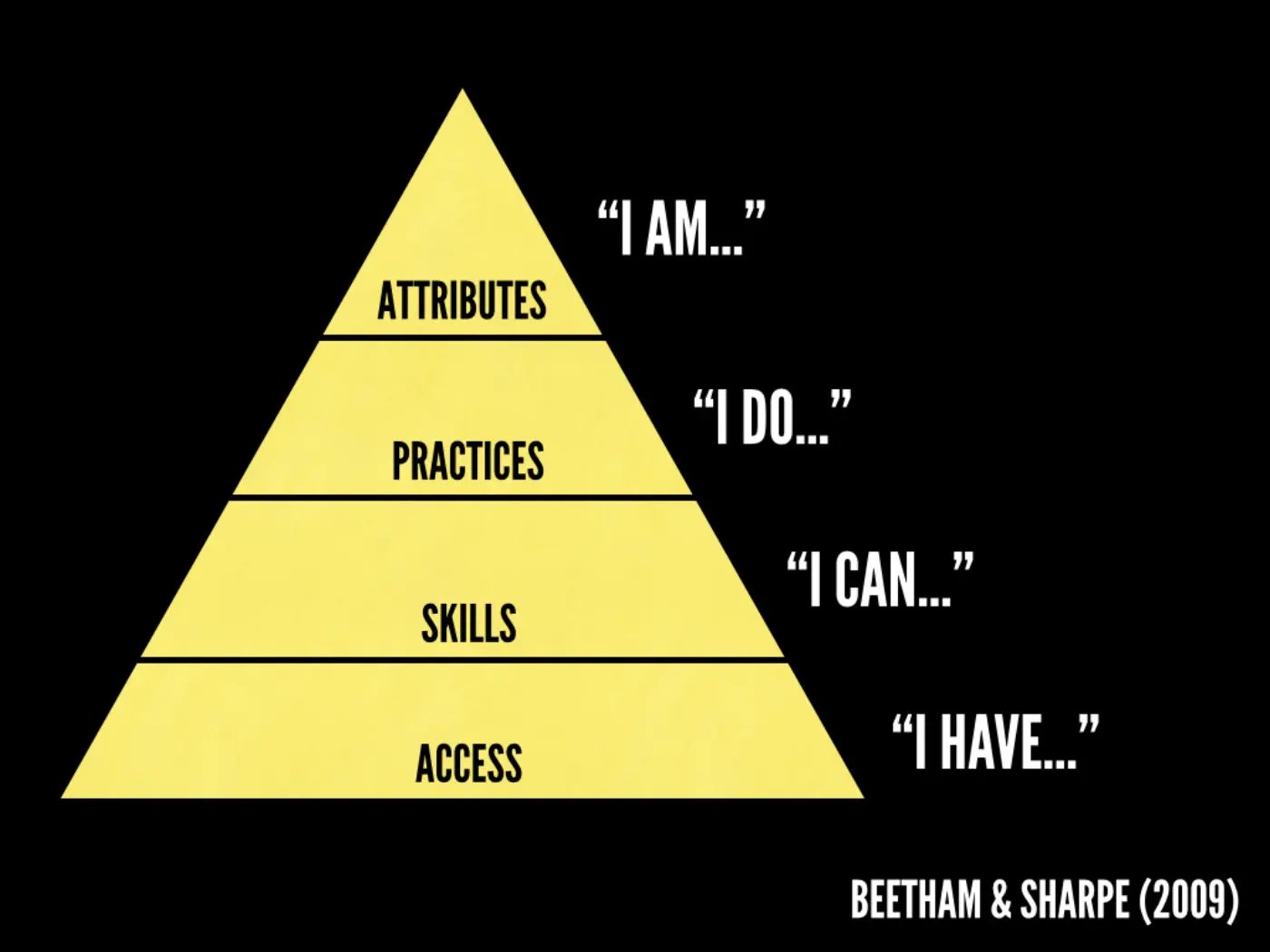
This is my version of a diagram that's explained in this post and comes from original work by Helen Beetham and Rhona Sharpe. It's ostensibly about digital literacies, but I think it's much more widely applicable. It's a development model that we can apply to educators becoming more familiar, and at ease with, open education.
Right now, there's been enough work done around the emerging area of 'Open Educational Practices' for me to state with some confidence that at least pockets of the wider ecosystem are moving beyond just OERs. There's even a badged online course for those who are curious.
What we need to do, and like many things, this is an identity issue, we need to move to the top of Beetham and Sharpe's pyramid and think about what it means for people to identify as an 'open educator'. It's great having a fairly loose definition that appeals to those in the know within the extant community, but it's more than a little confusing for those new to the whole thing.
Ideally, I'd like to see 'open education' move into the realm of what I term productive ambiguity. That is to say, we can do some work with the idea and start growing the movement beyond small pockets here and there. I'm greatly inspired by Douglas Rushkoff's new Team Human podcast at the moment, feeling that it's justified the stance that I and others have taken for using technology to make us more human (e.g. setting up a co-operative) and against the reverse (e.g. blockchain).
One way we can do this which is working at the top end of the pyramid is to make reclaiming our identity on the web easier to do. Reclaim Hosting is definitely doing a great job around this on the technical side, but we need something equally awesome (and not just short-term project-funded) on the cultural side of things.
So yes, in short...